
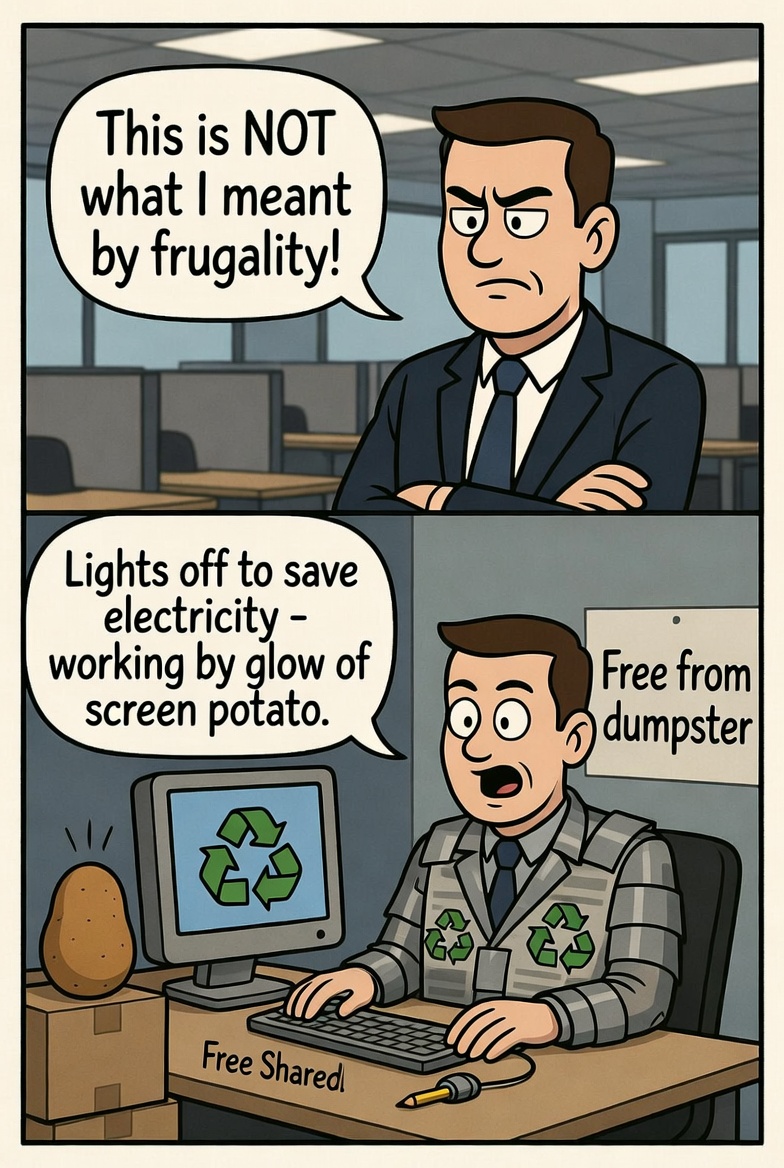
In this Tough Things First podcast, Ray Zinn tells us about how embedding careful spending habits (without being cheap) builds discipline across the company.
Rob Artigo: Some leaders treat spending like a scorecard. The more you spend, the more successful you look. I’m Rob Artigo, your host for this edition of the Tough Things First podcast with Ray Zinn, the longest-serving CEO in Silicon Valley history. Hi, Ray.
Ray Zinn: Hi, Rob. Good to be with you today.
Rob Artigo: It’s great to be with you. At Micrel, you turned careful spending into a competitive superpower. Today, that’s what we’re exploring here. How you institutionalized frugality: not cheapness, but disciplined thrift. Ray, welcome. And you often say cash is king, at least that’s your actions. How did you turn frugality into an ingrained part of Micrel’s culture, rather than just a temporary policy?
Ray Zinn: Well, I always think of what can go wrong will go wrong, as in Murphy’s law. I know in flying my airplane that I want to make sure I have enough fuel in the tank to get me out of trouble. We call it an alternate airport. The FAA tells you you should have at least enough to get to your destination, and then have another 45 minutes to get to an alternate airport, because weather can change, or situation can change where you can’t always get to where you want to go at that particular moment.
The key here is to have some reserve. If you don’t have a reserve, I guarantee you you’re going to end up in a situation that you will regret. Frugality, it’s like flying a plane. Don’t burn as much fuel as you can to go too quicker, because you may pay that price on the other end. Liken it to flying. We call it the reserve. You want to have a reserve. I don’t know of a single pilot that’s a qualified, good pilot, that doesn’t have a reserve. And that’s that frugal point. Again, just because you can fly faster, doesn’t mean that’s the best way to go, especially if you’re going to limit your runway, your ability to land safely.
Rob Artigo: And you’ve shared that this mindset helped Micrel survive industry cycles that sank many of the competitors. You’ve told stories here on the podcast. If you look back on your career at Micrel, there are a couple of circumstances. I think at the very beginning, one of the interesting stories was about how you had to, on a budget that didn’t take venture capital to do, was to create a fab for semiconductors. And in order to do that, you picked up some of the older equipment because it was on sale, and you were able to make use of that and make the fab work.
Ray Zinn: Yes. Again, I liken it to these examples that we have. If used equipment will do you just as well, then definitely go that route as opposed to always buying everything brand new. There’s some downside, of course, of buying used equipment. It’s going to fail quicker, and you’re going to have downtime. If you can’t afford that downtime, then you’re going to have to buy newer equipment.
I liken it, again, to flying. If you keep your maintenance up good on it, and then you keep everything in ship shape, then you’re less likely to have a problem. Just because you have money in a bank. Doesn’t mean you have to spend it. And the same thing with equipment or with employees. Don’t exaggerate your need, thinking that business is going to go straight up, and then you then have to lay off all these people. Being careful is the key to having a reserve. Be careful as you run your company or your life.
Rob Artigo: Does that help build broader discipline across the company, and prepare leaders for the economic storms ahead?
Ray Zinn: Absolutely. It really goes to how you’ve mentored your people. As I was talking to my pilot yesterday, we were talking about his having to go back to be certified in Florida, and I was chuckling, thinking how he was cautious about how much money he spent. He got a hotel closer to the training school so he could walk, as opposed to getting a car. He was also concerned about the kind of restaurants he went to, so he didn’t overspend.
And so he put himself on a budget. And even though I didn’t tell him to, because of the way we run our business, we look for frugality. So that was ingrained in him as he went on that trip, that he wanted to make sure he didn’t overspend on that training. So I was tickled to hear that yesterday as we were chatting about his training recently last week.
Rob Artigo: I had some experiences recently where I was away in a hotel for a week, and one thing I did was I brought milk for the refrigerator and boxes of breakfast cereal, and that’s what I ate in the morning. And that was something in the past where I would go to the hotel’s lobby and have breakfast there, which usually going to be more calories, more fat, and that sort of thing. But mostly, let’s say it’s $20 a day that I’m spending on breakfast. Well, if I’m there for five days, that’s a hundred bucks that I didn’t need to spend. I probably spent $12 on the milk and the cereal boxes. It makes sense to just get into that habit, because a penny saved is a penny earned, and looks good, but it’s real value. It doesn’t just look good. It’s real value, right?
Ray Zinn: Absolutely. As you say, a penny saved is a penny earned. I learned that as a child. I grew up in a family where I was the oldest of 11 children, and we had to reuse a lot of things. We hand out our shoes, we hand down some clothes to the younger children, and you didn’t look at you were being a cheapskate, you looked at it as being frugal.
So being frugal, it doesn’t mean you’re a cheapskate. It just means that you’re minding your wares, as you would, minding your income and not spending when you don’t have to spend.
Rob Artigo: Yeah. Wise words, Ray. Institutionalized frugality isn’t about cutting corners, it’s about building strength that lasts through good times and bad. So thanks for sharing that. Lessons from your 34, I mean, 37 years at Micrel. I don’t want to shortchange you there, speaking of money. Listeners, explore Ray’s books, Tough Things First and the Essential Leader. If today’s podcast hit home with you, subscribe, leave a review, and share it with a leader who could use this particular superpower. Until next time, do the tough things first, including making every dollar count. Right, Ray?
Ray Zinn: Let’s do it. Frugality is not cheap. Frugality is just good sense, good practice.
 as Competitive Superpower)