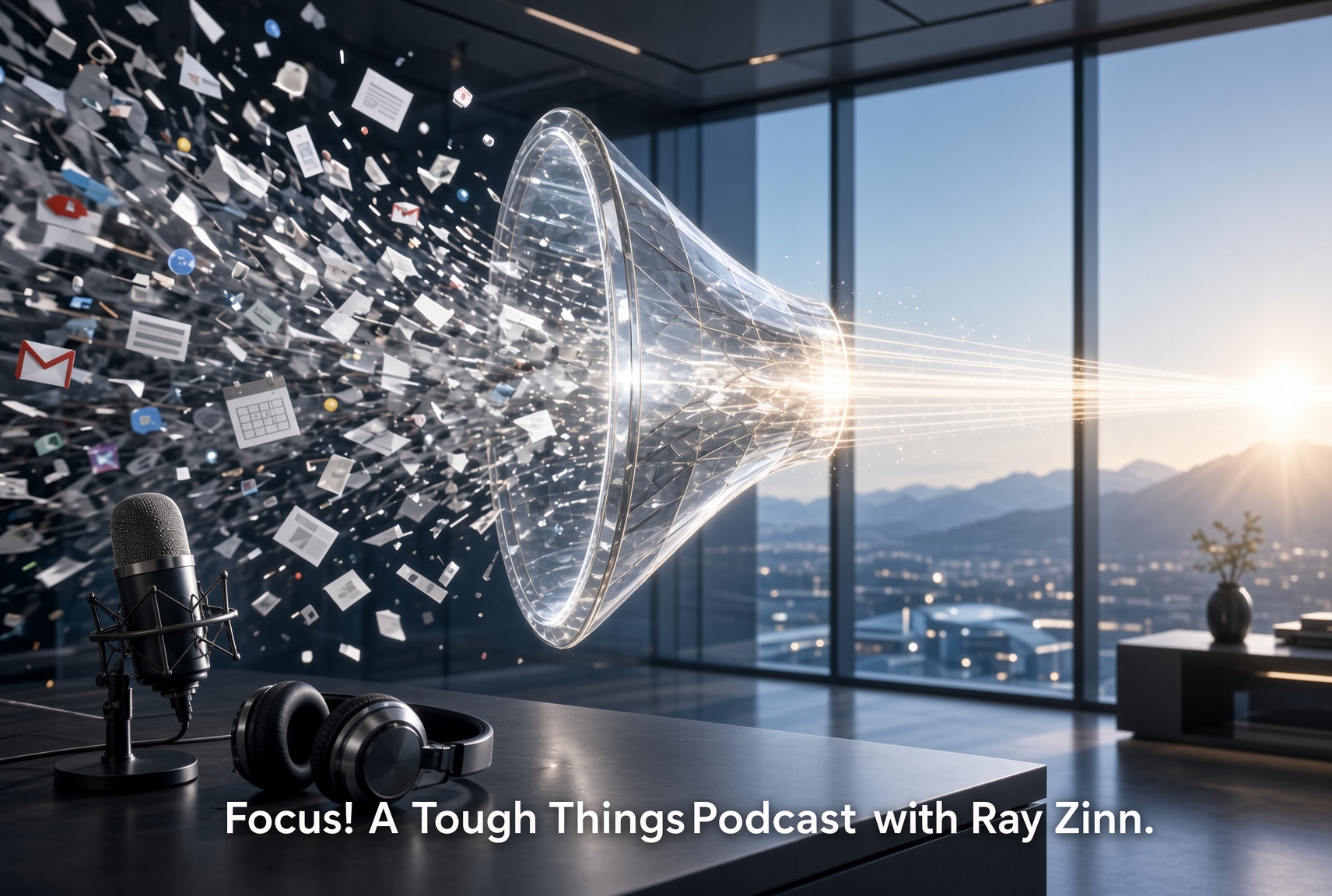
A focus filter is for making better decisions like getting rid of good but not great projects, and creating daily rituals that leaders can use to audit their own calendars and team building meetings. Ray Zinn Discusses that a decision tool for alignment with core vision, resource cost, long-term payoff)
Rob Artigo: Ray, today we’re discussing a practical tool for every leader. Every leader should have this, a simple tool. As a matter of fact, it’s called a focus filter for making better decisions like killing or getting rid of those good but not great projects, and also creating daily rituals that leaders can use to audit their own calendars and team building meetings.
So Ray, why do so many leaders struggle with focus? And how does a simple filter help cut through that noise?
Ray Zinn: Well, let’s define what a filter is. A filter is the thing that eliminates or reduces the amount of things that you want to keep out of whatever it is you’re doing. That’s called filtering. We do it in television, we do it in radio, we do it in water, the water we drink, we filter out the bad stuff. And so the purpose of having a focus filter is that you want to eliminate or at least minimize the amount of stuff that’s getting through that you don’t want to have to go through. So it’s a restrictor. It’s an inhibitor. And if you have a good filter, then you won’t get distracted. You won’t get overwhelmed with the stuff that you shouldn’t be involved with.
And so every strong, every good leader has to have a good filter and not let that, as they say, that junk come through, especially if it harms the company.
Rob Artigo: Let’s think about your personal focus filter. So what are some of the questions that come to mind that you think a leader should ask before saying yes to a new project, initiative, or opportunity? I know some of them are, give me the pros and cons.
Ray Zinn: Exactly. Well, you just led me right into it. So you have to decide before you have to decide. So deciding before you decide is the important thing. I know it sounds like an oxymoron. How do you decide before you decide? Is because you have those restrictors in there. You know what kind of filter to put in place before you have to put it in, because you’ve got to know your filter. And having that series of pros and cons, you want to understand that.
The cons, in many respects, are just as good as the pros because you understand what you want to get rid of. So for example, like during the COVID pandemic we had these masks that we wore. But we just put them on as a covering, more of a show, then they weren’t really helping at all because they weren’t filtering out anything. They’re more for show than for go, as they say. And so having that filter, you must know what you want to remove. And so having those defined in advance helps you, makes the better decision for the projects or the opportunities that you’re going to invest in.
Rob Artigo: Do you have an example of a time when you were at Micrel where you killed a good but not great project because you used this kind of filter? And what was the payoff from doing it?
Ray Zinn: Okay. So the one that comes to mind is we had a project that we could not build in-house, so we had to go outside. And the only one that was viable at the time, we had to produce it in China. I was reluctant. My filter was I didn’t want to build in China. And you can see that’s happening even today. A lot of the tech companies are trying now to build their manufacturing in the US and not relying on China. So the issue was not the relying on China. The issue was that if you relied on China, you had exposure and you had risk.
Again, if you have immunity, if you have a vaccine that prevents you from catching a disease, then you’re less likely to catch that particular disease. And so you can be around people who have a disease that you’re immune to, and that’s fine. But in our case, we didn’t have any immunity to that particular product if it was made in China. And so I canceled the project because we just didn’t have any immunity and I didn’t want to chance it. I mean, you’re gambling and I would have gambled if I had done it, and so I didn’t go through with that project.
Rob Artigo: Yeah. I guess you can’t prove a negative. So you don’t know with that example exactly what the benefit was because you can’t see both avenues, what the results were of both avenues. But it’s a fair, in retrospect, looking at what has happened in the tech world regarding China and intellectual property, and just patent infringement and all that sort of thing, suddenly it comes pretty clear that that was some forward thinking and it was tough decision making, I suppose.
Ray Zinn: Well, it was. I mean, it looked good on paper. It just didn’t feel good. In other words, I was concerned about the intellectual property was the main concern. And it was going to expose us to some competition from China that I really wasn’t comfortable with. And it wasn’t just going to affect our company, it would affect technology within the United States. So in other words, I’d be giving out technology that would be valuable to China, but it would harm other of my competitors even, or my customers.
Rob Artigo: Wow. In a world of shiny distractions that technology is out there, and there are good ideas that are plenty, why is a ruthless focus on one of the ultimate advantages for building an enduring company?
Ray Zinn: It’s necessary. It’s absolutely imperative. If you’re not filtering correctly, you’re going to catch a lot of diseases. We’re not referring necessarily to medical diseases, but you’re going to be susceptible to a lot of financial diseases. Also some other intellectual issues, a disease could happen. So being aware of the diseases you’re trying to filter out is important.
Rob Artigo: Rugs can be pulled out from underneath you. All kinds of metaphors for how things work in the business world. I mean, even talent, if you’re operating a company that is really competitive and it’s not that great a place to work, you’re going to have people who are going to be willing to go elsewhere. It’s another way that this sort of stuff gets lost because they take what they learned at your company someplace else.
Ray Zinn: Absolutely.
Rob Artigo: And sometimes that’s the main reason for that other company taking that person. “Oh, that person worked on these projects for that successful company. Let’s take that person and see if we can get some of that mojo over here.”
Ray Zinn: And they do, and that’s exactly what they do.
Rob Artigo: Thank you as always. Some really good information there to our listeners. I got an idea. How about pick one decision or a meeting that you’ve got coming up and just run it through in the simple focus filter. Does it align with your core vision? What’s your true resource cost? And what’s the long-term payoff? And sometimes you don’t know the real long-term payoff until sometime later, but you’ve got to trust that. And if you’ve got a good focus filter, you’re going to be able to trust that. That’s what the essential leader does.
So join the conversation at toughthingsfirst.com. Your questions and comments are always welcome. Follow Ray on X, Facebook, and LinkedIn. Pick up Ray’s books, Tough Things First, and also The Essential Leader with the Zen of Zinn series one, two, and three. And now Ray’s new book, Zen of Zinn Daily. Until next time, do the tough things first, right, Ray?
Ray Zinn: Exactly right. Thanks, Rob.
