
By Ray Zinn, Silicon Valley’s Longest-Serving CEO
Artificial intelligence is advancing at a pace few could have imagined even five years ago. Every week brings new breakthroughs — new models, new capabilities, new promises. And recently, new security failures from some of the world’s most sophisticated AI companies.
But the real issue isn’t the breach. It’s the leadership gap behind it.
Technology is accelerating. Leadership discipline is not. And that gap is where risk grows.
AI doesn’t need smarter machines nearly as much as it needs wiser leaders.
Innovation Without Responsibility Isn’t Progress — It’s Hazard
Every major technological shift has tested leadership. But AI has proven to be different. It moves faster, scales wider, and amplifies consequences instantly.
When leaders chase capability without strengthening governance, they create organizations where:
- Trust becomes fragile
- Culture becomes reactive
- Risks multiply quietly
- Shortcuts become normalized
The breach is never the first failure. It’s the final symptom of leadership that didn’t grow as fast as its technology.
Trust: The First Step in Responsible AI
Trust is the foundation of every enduring company. It’s earned slowly and lost quickly.
AI security failures aren’t just technical breakdowns — they’re cultural ones. They reveal whether leaders have built organizations grounded in:
- Accountability
- Transparency
- Long‑term thinking
- Disciplined decision‑making
Trust doesn’t collapse because of one incident. It collapses because leaders failed to build systems that prevent one.
Corporate Culture Determines AI Behavior
AI doesn’t create culture. AI amplifies culture.
A disciplined culture produces disciplined AI. A reckless culture produces reckless AI.
If leaders reward speed over wisdom, ego over accountability, or “ship now, fix later” thinking, their AI systems will reflect those values. Technology becomes a mirror—revealing the character of the people who built it.
This is why responsible AI begins long before the first line of code. It begins with the leader.
A Micrel Example: What You Can Do vs. What You Should Do
At Micrel, I learned that the hardest leadership decisions often came when engineering told us what we could do, while judgment had to determine what we should do.
That distinction — capability vs. responsibility — is the same tension leaders face with AI today.
Risk Management Must Evolve as Fast as AI
Traditional risk frameworks were built for predictable systems — not self‑learning ones.
Responsible AI leadership requires:
- Understanding how AI behaves under stress
- Anticipating unintended consequences
- Building safeguards before scaling
- Ensuring human judgment remains the final decision‑maker
Risk management can’t be a compliance checkbox. It must be a leadership discipline.
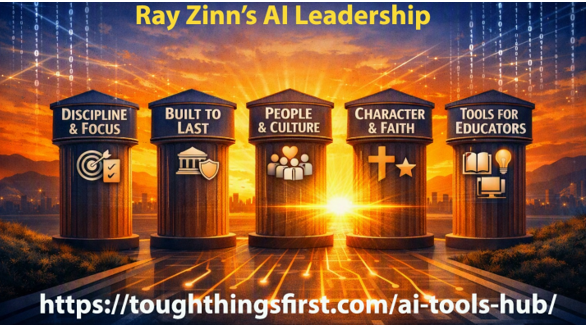
Why I Built the AI Tools Hub
My AI Tools Hub was created with one purpose: To strengthen human judgment — not replace it.
AI should help leaders:
- Think more clearly
- Communicate more effectively
- Make decisions with discipline
- Lead with long‑term perspective
The Real AI Revolution Is Leadership
The world doesn’t need more powerful algorithms. It needs leaders who:
- Protect trust
- Build strong cultures
- Manage risk with discipline
- Use AI to serve people, not replace them
Innovation matters. But responsible innovation is what endures.
Do the tough things first. Lead with wisdom. And let technology follow—not dictate—the path.
