
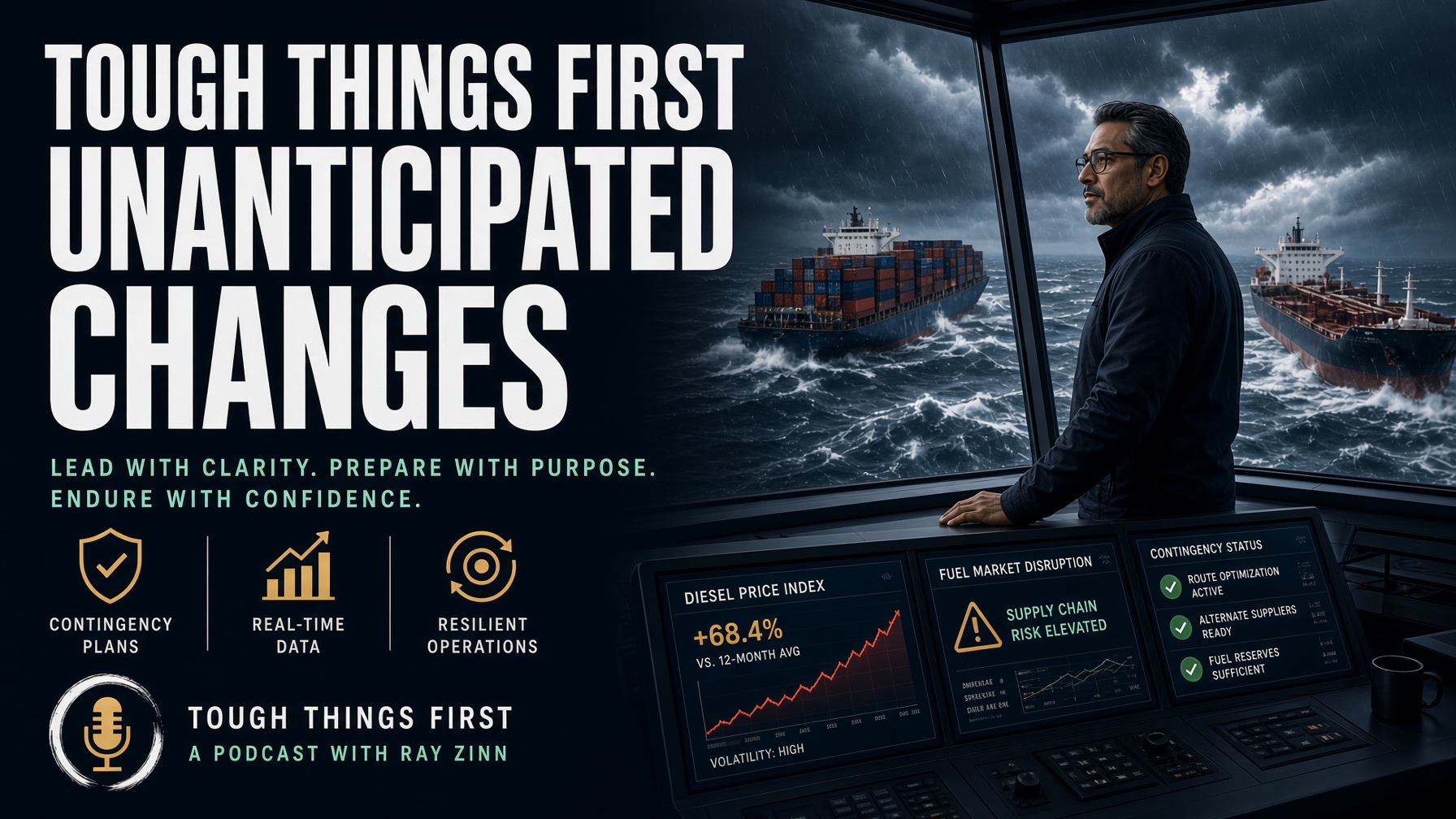
From Covid to hurricanes and supply chains, there is no telling what you and your company may face, but just because it is unpredictable and sudden, doesn’t mean you shouldn’t be prepared. In this Tough Things First podcast, Ray Zinn explores the challenges and solutions of the wild circumstances you are likely to face when you least expect it.
Rob Artigo: Ray, today we’re talking about something every leader eventually faces, unanticipated change. That’s the kind of change that hits fast. It disrupts everything and can feel like the start of a doom spiral if you’re not careful, but it doesn’t have to be a doom spiral. It’s a crisis that has to be managed and endured. But a key here is being prepared. I think that’s going to be something that you’re going to bring up. I want to set this up with the real world example of diesel prices right now, the sharp rise of diesel costs, driving up shipping costs across the board. It means higher prices for materials, deliveries, squeezed margins of pressure on customers who suddenly can’t afford what they could afford just maybe a couple of months ago. It’s the kind of economic shift that no one put on the calendar.
One day, fuel’s manageable. The next day, it’s a line-item problem that touches almost everything you do. So let’s start… When something like a sudden spike in fuel and shipping costs lands on your desk, something you couldn’t plan for in the first place, what’s the first thing a leader should do so it doesn’t turn into a panic or a paralysis?
Ray Zinn: Well, because we talk about everything being wonderful and nothing ever going wrong, but that’s just not the way life is. Life has unexpected changes and challenges that we face every single day. As they say, you plan your life as though there’s never going to be a disaster, but you live your life as though there’s going to be one tomorrow. So you got to be ready. You have to be focused on what’s going to happen and being anticipatory of calamities and changes that can and will affect you. It might be a loss of a leader in your company. It might be a health issue that you face that could be economic downturn. And as we talked about just now, or if you’re a shipping company and you rely heavily on diesel fuel to move your goods, that could be a real challenge. And so all challenges and difficult problems as you would, are difficult to deal with, but that’s running a company.
Ray Zinn cont: Just assure yourself that running your company is going to be a challenge, that you’re going to have these unexpected challenges that come up and you have to be prepared for them. So you want to build in enough margin in your product line. And this is that thing we talked about before, Rob, about companies that grow too fast. What they do is they price themselves really low. They don’t worry about margin because their investors are more concerned about revenue growth and not about profitability. But if you are doing the tough things first or if you’re being an essential leader and being an enduring leader, you want to have margin. You want to have enough profitability built into your revenue stream that you can endure these unexpected changes, whether it be an economic downturn, which can last a couple of years. They can be as short as six months, but average is about a year and a half.
So in this particular case, we have this diesel shortage that’s been kind of with us for the last three months. You just have to be able to hang in there. You got to have that margin built into your business such that you can endure the pain of the higher cost of fuel or whatever else that might be impacting your business. So growing fast, that sounds good. I mean, everybody claps and said, “Oh, look how fast they’re doubling revenue and they’re just going right, doing fantastic.” But when a calamity hits, their revenue drops off like a rock, then their margins are zero and maybe negative because they’re trying to grow revenue and they’re sacrificing margin for revenue growth. And then that ends up coming back to bite them.
Rob Artigo: Well, you alluded to this. I know that, talk about being prepared, but interest rates move, a key supplier has problems, a customer base shrinks overnight and these tariffs, you never know when those are going to change. The specific change is, I mean, might be different each time, but the disruption is the same. You ran Micrel for 37 years, you’ve seen multiple economic cycles. When the numbers suddenly look different than they did last quarter, how do you separate the temporary noise from the real structural problems that need attention?
Ray Zinn: Building margin into your business so that your company’s profitable and highly profitable, the biggest deterrent to having a difficult situation in your company when an economic or some other calamity hits your business. It’s those companies that are just, revenues are going out of sight, they’re tripling, quadrupling revenue, and they do that by sacrificing margin. They just say, “We’re not going to worry about our profitability right now because most investors know when you’re a startup or they prefer you grow your revenue like crazy and they say heck with margin.” Well, the investor’s not running your company, you are. And so the companies that really have difficulty during a downturn are companies that are sacrificing margin for revenue growth.
Rob Artigo: Well, let’s shift to a different kind of unanticipated change, one that feels more personal inside of a company. You mentioned this and I thought it was a great note to put in here and to focus on, the loss of a critical employee, not one who is easily replaced, but a person who maybe holds key relationships, deep institutional knowledge, or a skillset the other team members really rely on or depend on. One day they’re there, the next day they’re not. It could be illness, resignation, retirement or something else. The work still has to get done. How do you keep that from becoming a crisis that ripples through the whole organization?
Ray Zinn: Well, having that duplicity, not having that capability all circled into one individual. Relying on just one person, whether it be yourself or one of your critical teammates, you have to have some duplication. And so I had that happen to us in 2005 when my partner got really ill and it looked like that was going to be a real disaster for us, but we had enough duplication that we were able to carry on. There were some changes we had to make, but they weren’t so significant that it hurt the company.
Rob Artigo: Yeah. I think we’ve talked before about being prepared, preparing your organization for an eventual transition. You always want to have a plan in place just in case and then have people that are groomed to have the knowledge so that there isn’t much of a disruption. There’s always going to be a disruption when a key person is gone. But what should a leader do in the first few days or weeks so the remaining team doesn’t feel abandoned or overwhelmed and so the business doesn’t stall while you figure out what the long-term answer is going to be?
Ray Zinn: Well, by having a positive attitude. The one thing that I like to focus on is being happy even during a disaster or during a difficult time. So as I say, look for the positive, accentuate the positive, not the negative as that song goes. A spoonful of sugar helps the medicine go down. So if you remain happy or remain positive, may not remain upbeat, that keeps the team motivated and excited. And even though you’re facing this major dilemma, you’re not letting it impact the morale of the organization. What you do is during a downturn or during a difficult period, try to find something positive to focus on, whether it be this increased diesel cost, look at the upside and be happy. That’s the key really to keep the team motivated and keep them excited because if you go into the dumps as you would or you get down on the organization, it’ll affect them.
And of course, as we all know, negativity actually hurts the company, not anything else. It’s really the attitude of the company that will remain strong if it’s the right kind of attitude. So that’s what I did at Micrel for 37 years, was I remained upbeat, remained positive, remained solid behind what we were doing, always acting enthusiastic, acting energetic, not hiding as you would in the closet, being out there with them, patting them on the back, telling them how great things are, wonderful things are. They want to hear that. People want to hear good news. They don’t want to hear bad news. And so try to find good news inside of this dilemma or this transition that you’re facing.
Rob Artigo: Let’s look at natural disasters. The Gulf Coast is still reeling from another hurricane, but we also have fires. We have plenty of them here in California. There are earthquakes. There’s other kinds of severe weather that happens. Facilities get damaged or they become inaccessible. People get displaced. Supply lines are cut. Customers in affected areas are unable to operate. And if you’re manufacturing, some places can’t manufacture. So that part gets affected. Suddenly the entire operating environment has changed and you may not even know the full extent of the damage for days. How does a leader approach something like that differently from an economic shift or a loss of an employee? And what does managing and enduring actually look like when parts of the business are literally offline or destroyed?
Ray Zinn: It’s interesting that really these disasters really are very upbeat because people jump in and help each other. If you take, whether it be the earthquake or the hurricane or whatever, when people jump in and help, plowing through the rubble to find people alive or removing trees. And I remember when we had that one bad one several years ago, people from miles and miles around brought their trucks in and helped clean up. I think it was Katrina. I think it was Hurricane Katrina. People from surrounding areas jumped in and brought chainsaws and that’s a very upbeat thing. When people help each other, that’s very upbeat. That’s very positive. And so the key is, is that staying upbeat, staying positive, helping others, not worrying about yourself, focusing on others as you would is the key to managing through a difficult situation.
Rob Artigo: Across all of these different kinds of disruptions, the diesel prices, and shipping costs, losing a key person, or natural disasters, the common thread seems to be that the change arrives unannounced and creates real disruption. And it can feel like the start of a downward spiral, if leaders treat it that way anyway. But you’ve always said that the tough things are the ones that build lasting success. So as we close out here, what’s the mindset shift as a leader that a leader has to make right in the middle of this thing to manage it and I guess seize the moment so the team sees it as a crisis to be managed and endured rather than end of story? And I know you mentioned having a positive attitude, but I mean that might be the tough thing that you have to do because in the face of things, it’s hard to have that, put on that air of being positive.
Ray Zinn: Well, you just said it. I mean the whole success formula for overcoming a dilemma is to remain upbeat, and happy, and positive, looking on the bright side as opposed to woe is me, getting down because your attitude as a leader really will impact those with whom you work.
Rob Artigo: For our listeners, I sure would like to invite them to toughthingsfirst.com. Questions and comments are welcome there. Follow Ray on X, Facebook, and LinkedIn, and of course pick up the books Tough Things First, The Essential Leader, and the Zen of Zinn series one, two, and three, including Ray’s book, the Zen of Zinn Daily. Until next time, do the tough things first, right Ray?
Ray Zinn: Let’s do it.
