
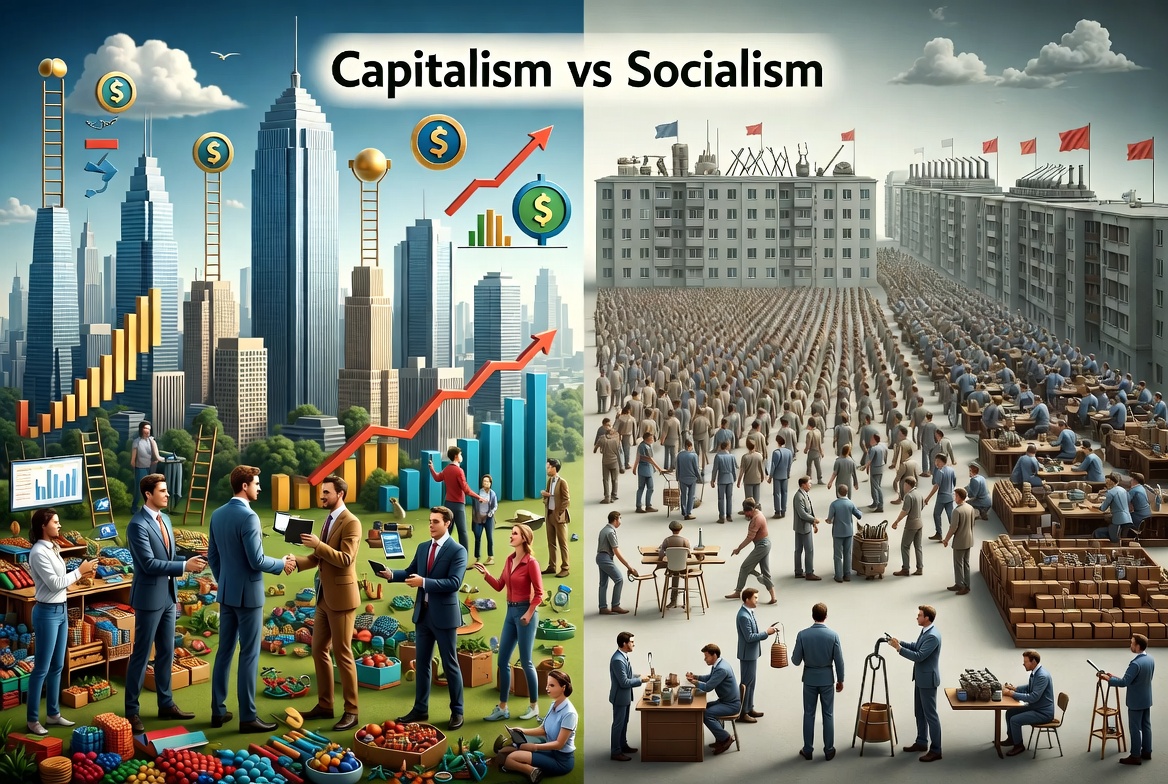
In a world divided by competing visions of prosperity, today on Tough Things First we tackle one of the most consequential debates in human history: Capitalism versus Socialism. Ray Zinn cuts through the ideology, examines real-world outcomes, and explores which system better delivers freedom, innovation, and human flourishing. (Watch Now…)
Rob Artigo: Big topic, Ray, in modern America, capitalism versus socialism. We have a real debate going on. We have the admitted socialist, maybe even a communist as a mayor of New York and other folks coming online as viable political candidates who are socialists who say they’re socialists and they don’t care if there’s a bad connotation to that or bad history related to that. So let’s start with the basics, Ray. In simple terms, what do you see as the core strengths of capitalism?
Ray Zinn: Well, capitalism is more of a nationalistic type economy. Everybody does their thing. Everybody gets paid for the labors, efforts that they put in, including companies. And so our country has always been based on more of a nationalistic, capitalistic society. It’s really more of you get what you pay for or you pay what you get. It has a strong growth potential because of the nature of it. If you can get what you need to get based on your income and your social status, then capitalism is good. And the purpose of capitalism really is to grow. I mean, capitalism is based on growth. And so capitalist societies tend to grow much faster than socialistic societies.
Ray Zinn Cont: So switching to socialism, socialism is based on social programs, based on giveaway type like food and shelter and health welfare. And so it’s more non-nationalistic. And that’s why you’ll see people who are more socialistic tend to not have borders. In other words, they lack borders. The key here in socialism is that it’s more focused on programs that favor the underdog or people who are down and out as you would because they’re more freebie. You rely heavily on the power of the economy to fund these social programs such as food, shelter, health, and they can refer to these as the basic needs. So as I said, again, they’re more related to no borders.
Now a communist society is a little different because they do have borders. If you look at all the communist countries, they’re more border related because they have to be by their nature because the government basically takes care of everybody. In other words, they run the system. But the problem is that government run programs are never very efficient. Anytime you have giveaways or freebies, they get taken advantage of and a lot more fraud.
If we look at the countries that are more socialistic as you would, there’s a lot more fraud because people take advantage of the freebies as you would or the socialistic type giveaways and they’re easy to take advantage of. Not so much under communism because the communists… Now the upper level of the communist party, the higher levels, they survive well. So I have relatives in Germany that were there under the Russians in East Germany and they said it’s terrible.
I mean, they said they were so happy when West Germany took over East Germany and it became one country. They hated being under the communist rule. And we know that wall, the Berlin Wall and the wall that separated East Germany from West Germany was put up by the communist. So they are very strong on borders and they’re very strong on keeping everybody under their thumb as you would.
Again, they suffered greatly under communism. My relatives did in Germany. I remember visiting them in the late ’80s, early ’90s and they didn’t have all the facilities we have here. They didn’t even have a toilet. I mean, they had a hole that they did their stuff in and their home was very ancient looking. In other words, when I went there, they pumped the water from an outside well and then they carried into the house. I mean, it reminded me so much of a underprivileged country and a third world country as you would. And so they were very happy to be part of Germany as a whole. And there was some adjustment they needed in order to do that because the two systems were totally different. West Germany was capitalistic and East Germany was communistic.
So now back on socialism. Socialism it’s a roadmap to communism and it is very border-centric. I mean socialism is not, but communism is very border-centric. And so socialism, we’re all one people, we’re all one country, we’re all one world. And so the love of country, the love of each other is different under socialism. You can see what Europe or England is going through right now. They’ve got way too much immigration. They actually can’t support that because the immigrants who are flooding the country need all these social services.
Under Biden, of course, the borders were open and a lot of socialism crept in. And so what we’re seeing now in the US is a consequence of all of that immigration that took place and then people saying, “Oh gosh, this is really great because everything is free. Free food, free cellphones, free rent, free health.” But nothing is free. There’s nothing in life worth having is free. And so there is a need for socialism in certain areas. Certain people need help and we should be there to help them. But making the whole country socialistic is dangerous and we’re going to slow our growth.
Our growth will slow down next to nothing. And so we can see that under the current administration, the markets are doing well, the growth is good and our borders are closed. But the people who are for socialism are upset because the socialistic programs in their mind are being minimized because they’re seeing all the growth and all the advantages of the wealthy, the billionaires, as you would, are looked upon as being evil as you would even. So in our country, in the United States of 300 plus million people, there are only 900 billionaires. And so if you’re going to tax 900 people, you’re not going to be able to support socialism on just billionaires.
Those who are promoting socialism are the ones that are more rioting. They’re more unrest as you would and they’re a very fanatical group. I personally am in favor of capitalism and I’ve done well under capitalism. And I don’t see myself doing very well under socialism. I do agree that we will and should have programs to help the underprivileged and that’s the way it should be in any country.
Rob Artigo: Yeah. Let’s wrap it up by discussing the difference between socialism and even communism compared to capitalism. One big difference that comes to mind is opportunity, self-determination versus government determination, if that’s a good way to put it. There’s a term that I always learned about growing up, which was called pulling yourself up by your bootstraps. It seems like you can’t really pick yourself up from nothing and make something out of nothing if you don’t have an opportunity to pull yourself up by your bootstraps and that’s a big dividing line between capitalism versus socialism. Am I right?
Ray Zinn: Right. Countries like China are trying to do a modified communist versus capitalism. They’re trying to modify it, but again, it’s not going to work. I mean, the people in China aren’t doing near as well as those in Taiwan. And of course they see that. It’s kind of a dichotomy. And here you have this little state like Hong Kong was prior to 2000, was doing really well. And then now Taiwan is kind of like Hong Kong in the sense of the word that it wasn’t part of communist China. In the case of Taiwan, it’s not. But we look at Hong Kong. Hong Kong is not doing as well as they did when they were separate, when they were their own little group, as a little country. So we need to be careful. But, again, if you’re more of a nationalistic person rooting for your team as you would, then you want capitalism.
Rob Artigo: Yeah. It’s amazing when you think about the difference between Hong Kong today and Hong Kong in 2000. So that’s one great example. Imagine being in Hong Kong growing up in a capitalistic society, which is separate from mainland China and then waking up one day and finding out that now you’re under a communist regime that has total control over you and everything else. Let’s wrap this up. I want the listeners to check out The Essential Leader and Tough Things First. Those are the books. They’re available everywhere. Visit toughthingsfirst.com for the podcasts, blogs and more. Follow along on social media as well. And listeners, what’s your take on capitalism versus socialism? Drop your comments in the comments there at toughthingsfirst.com and do the tough things first. Thanks, Ray.
Ray Zinn: Thank you, Rob.
