
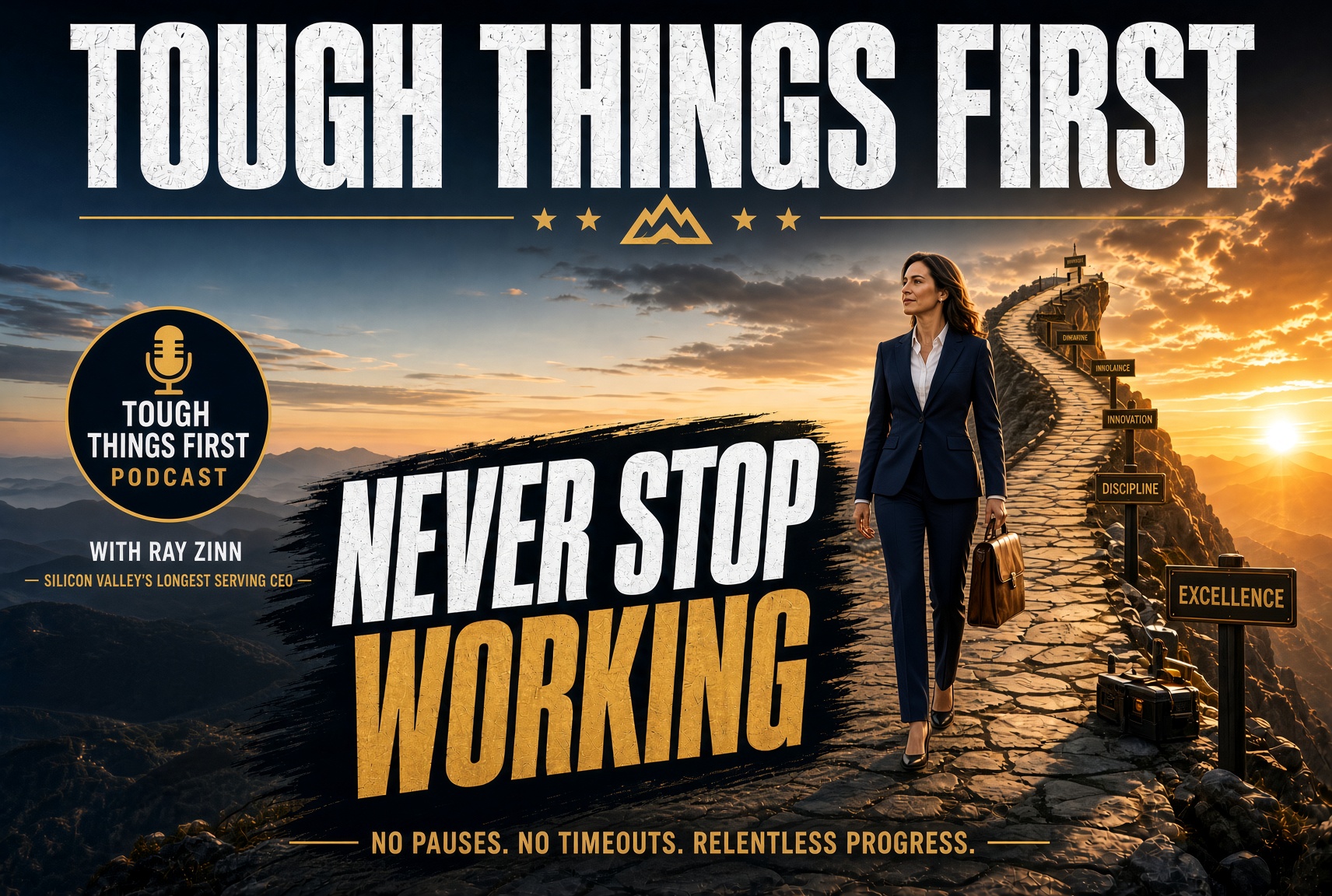
There are no time-outs on the path to excellence. In this Tough Things First podcast, Ray Zinn, Silicon Valley’s longest serving CEO, discusses longevity and why engaging your body and your brain in some form of work daily will help live longer and have a more satisfying and successful life.
Rob Artigo: Ray, I want to talk about something that is near and dear to your heart because you’re a guy who has… I can’t remember a time when you weren’t working. Go back to when you were on the farm, you were working and then you’ve worked and then you retired from Micrel after 37 years and yet you keep on working. So really the point of this podcast is never stop working. You’d like to say that there are no timeouts on the path to excellence. Tell me what you mean by that.
Ray Zinn: Well, we just have to consider ourselves as being able to live forever as you would. So to live forever means you got to work forever. The Bible said that God told Adam he had to work all the days of his life. I took that to heart. And so even though I sold the company in 2015, I actually became even busier. I wrote more books. I funded a company called ZinnStarter and I teach at various universities from time to time. And I just keep promoting effort, trying to keep the legacy alive as opposed to, “Oh, I remember Ray Zinn.” You want to be current. I know Ray Zinn is because I remember him. Even though I will turn 90 next year, I still keep going as though I’m in my 20s.
Ray Zinn cont: I’ve actually held a job since I’ve been 12, I mean a paying job. I don’t get paid so much now because I don’t have a revenue stream that pays me, but I do enjoy still doing things, whether we writing church hymns or writing books. In fact, we’re working on my seventh book right now. And also, we do these podcasts. We produce one or two a week and I still teach and ZinnStarter is like a Kickstarter for universities, has continued to get traction. We keep adding more and more schools to the program. When I roll over and give up the ghost, as they say, it won’t be because I was laying in bed, it’s because I was fell over working. I don’t want to be ever known as someone who’s taking it easy.
Rob Artigo: Yeah. The term that comes to mind is dying with your boots on in the act of working and living. I wonder if some of the conversations I’ve had recently with people who run businesses and have to hire younger and younger people or as time goes by, the staff gets older and then new people are coming in and they’re younger, they’re from different generations. Are you seeing a change in the generations now, the up and coming generations where the never-stop-working is more of a never start working attitude?
Ray Zinn: Yeah. I don’t know why these kids now, these younger people are seeking to live at home, look for jobs that are online. I can remember teaching a class several years ago in the Bay Area. When I came to the class to teach it, I was wearing a suit and these kids were all in their pajamas laying on bean bags.
Rob Artigo: Oh, God.
Ray Zinn: I just can’t get over that attitude. If you’re not dressed for work, you’re not working. And so oftentimes when we work from home or online, our hair’s not combed, we’re not shaven or we’re not dressed, we’re in our pajamas. We have a very lackadaisical attitude and COVID really caused this problem. People just absolutely quit working.
Well, I understand working online, you don’t have to commute and you’re still able to stay home and in a more relaxed atmosphere, we tend to get too relaxed. We tend to not take what we’re doing seriously. So if you are working online, get yourself cleaned up, get your hair combed, get yourself shaven or get yourself dressed properly. Even though you’re not online video wise, camera wise, your attitude changes when you get ready to work. Let’s get ready for work. Let’s get ready for work. Let’s not just go to work. So that’s the key is that people ask me, “Are you retired?” And I said, “Well, in a sense of the word, I don’t have a job where I get a monthly income. Yeah, I don’t do that, but I’m still working. I work at least eight to 10 hours a day, even though I’m not getting a regular paycheck.”
So I can tell you that my TV does not come on until around 7:00 at night where I will tend to watch a little news and sit back and relax for a couple hours before I go into bed. But I don’t watch TV during the daytime. I don’t do social media. I’m doing something. I make a list of every morning of what I want to get done for the day and then I tackle that. It drives me nuts not to have something to do because I don’t feel like I’m productive even though, as I mentioned, I turn 90 next year and yet I have no intention of laying back and taking it easy.
Rob Artigo: I did radio for 20 years and one of the early lessons I learned was smile when you’re on the radio and people are like, “Well, there’s no camera. Why would you need to smile?” Well, the smile reflects in what you sound like on the air. Your smile shows more energy. When people are listening, they hear more upbeat sounds and you feel positive too. So like you said, if you’re dressed right and you’re prepared, if you’re acting like it’s an important thing that you’re doing, then that is going to be reflected. And particularly if you’re online and you have to do video calls or podcasts like this, that you’re representing something that really reflects what you intend it to be.
Because if you sit on the couch and turn on your TV at noon, you’re not going to move, you’re not going to be productive. And that happens when people are working from home a lot is they end up being less productive because they’re doing their work in front of the TV.
Ray Zinn: Well, what I do do is I get up at six every morning. I begin exercising and exercise for an hour. Then I get cleaned up, wash my hair, shave, get myself all ready, dress up nice. We’re on video. This is the worst I dress. This is the way I look. Even I’m going to go out and milk the cows as you would. I dress up for every day and then I eat my breakfast and then get ready to do my chores that I want to get accomplished for the day. I do that until 6:00 at night when I have my dinner and then I slow down a little bit in the evening, maybe turn on a little TV and then get ready to go to bed and get a good night’s rest. I always go to bed by 10:00 and then I wake up at 6:00. So I get a good eight hours and I think that will help me physically.
So again, if you’re going to want to have a fulfilling life, don’t cut back. Don’t relax just because you’re not getting a monthly paycheck or a weekly paycheck.
Rob Artigo: Yeah. And if you are one of those people who feel like you want to stay home and not do anything, then perhaps you need to rethink your plan for the future probably because you don’t have a plan. So that’s another topic for another day and we will cover that here on Tough Things First. Join the conversation at toughthingsfirst.com. Your questions and comments are always welcome there. Follow Ray on X, Facebook, and LinkedIn. And of course, pick up Ray’s books, Tough Things First, The Essential Leader, and the Zen of Zinn series one, two, and three, including Ray’s book, Zen of Zinn Daily. Until next time, do the tough things first. Right, Ray?
Ray Zinn: Let’s do it.
