
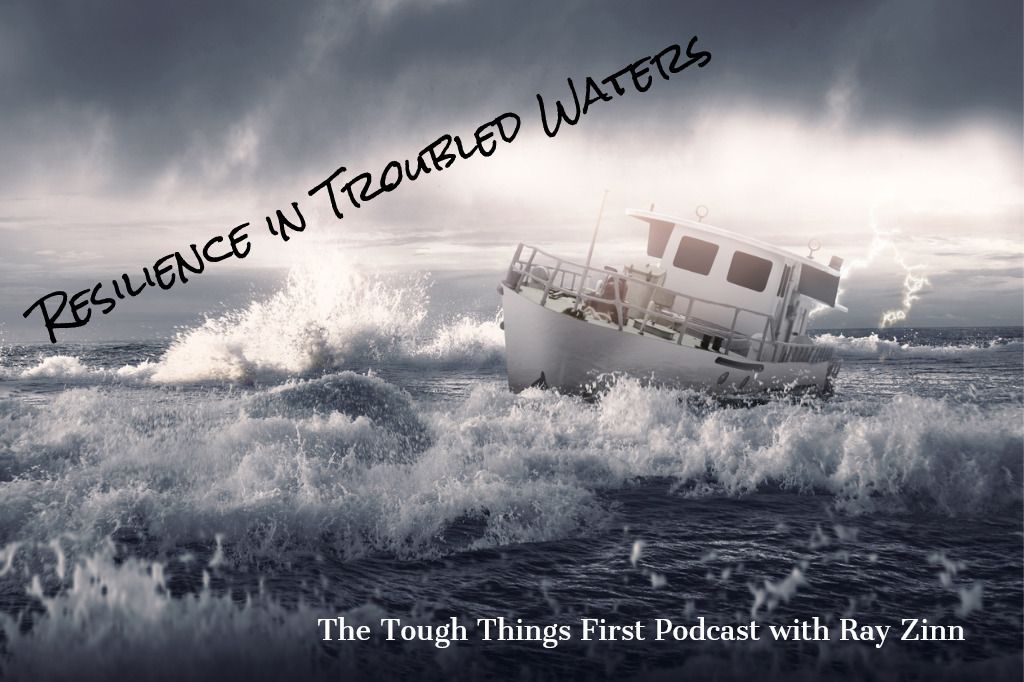
You can build resilience in your life and business so that no matter how bad it gets, you are ready. Ray Zinn knows a thing or two about navigating rough seas even when it seems nearly impossible.
Rob Artigo: At Micrel as CEO for so many years, your company was thriving in uncertain times, not just a survivor, it was a thriver. Resilience often starts at the individual level, especially during personal setbacks like health challenges. You lost your eyesight at a very important time in the company’s history, but you managed to get through that and stay as CEO until you finally left the company.
That could feel overwhelming, I’m sure those things… And they can feel permanent like vision loss. Hopefully, things improved over time, but you had that challenge. What practical strategies have you seen or personally used to reframe these hurdles as temporary, like rebuilding your inner strength and maintaining focus amid the uncertainty?
Ray Zinn: Well, that child story about the Little Train That Could is a good example. You just have to realize that life is going to have its ups and downs about half the time.
Ray Zinn Cont… In other words, half the time things are going to go well and half the time things are not going to go so well. You have to accept that. That’s something that’s like a basic law of physics is what I call it, where you just have to know that half the time you’re going to have downs as well as up. That’s flipping a coin, half heads, half tails.
And so, knowing that and not expecting everything to be on the upside will prepare you, then, for the downside because they’re going to happen. During my 37 years of running my Micrel, we had eight downturns, eight. I mean, significant downturns.
In 2002, we lost half of our customers, half of them. And our revenue fell in half. And we had to buckle down. I mean, we had to… Or buckle up, I guess is the term, and just stiff it out.
We lost money, but not much. We lost $50,000 out of several hundred million. And so, that was a real eye-opener for everybody to see how we… Because a lot of my competitors and customers went out of business when that dot-com thing hit, the downturn that happened.
The point I’m making here is that you got to expect downturns. They just come as sure as the sun comes up and the sun goes down. You’re going to have to deal with it. And just knowing that, you get prepared.
So, it’s like having a bumper on a car. You’re prepared to have an accident, as you would. I guess today’s cars are a little built differently. You probably don’t even remember bumpers on cars, but they’re there in case of an accident.
So you have to put bumpers on your company. You got to bolster your company to the point where it can withstand a downturn. That’s the key is making sure you have the bumpers on your company.
Rob Artigo: How can leaders cultivate this mindset for resilience? Seeing a setback and those times that are the worst times, like the most uncertain times, how do you see that as temporary and thrive or at least get through like the dot-com thing, like you said, a lot of companies were going out of business.
It took effort and focus by Micrel and you at the head to navigate that storm. How do you put it in your mind that it’s a temporary thing?
Ray Zinn: Well, a downturn usually lasts between a year and two years, and that’s the classical downturn cycle. I call it the first law of economics, both for every direction you have in one way, you have the opposite in the other.
What happens is when you do see a downturn, you fight it. In other words, you just dig in. That’s why a downturn doesn’t last as long as an upturn because you’re fighting hard to overcome that down cycle. It will turn around. As I said, a downturn usually lasts between a year and two years.
Knowing that, you get prepared for it. You say, “Okay, what do I need to stabilize my company over a year to two years?” And that’s what we did. We were able to get prepared because we knew it was coming.
And just like I mentioned earlier, you know the sun’s going to come at a certain time. The sun’s going to go down at a certain time and you just deal with it. You set your timer for your light to come on at dusk and your lights to go off at daylight. You set the timer.
So you get prepared. And if you are prepared, if you know that a downturn is going to happen and they happen every four to five years, you’ll get a downturn. These downturns are just as common as, as I said, the sun coming up and the sun going down.
Rob Artigo: There are all kinds of leaders out there, and I guess there’s a right way to do it and a wrong way to do it. What do you do when you have somebody in your leadership circle, your inner circle, who is the pessimist in that environment and says, “Look, I don’t know. I’m very concerned. I’m so concerned.”
And they can be paralyzed by the worry about the situation. How do you get them over that and get them on board with your, “Hey, this is temporary. Let’s forge ahead.”
Ray Zinn: Well, you would like to hire optimists, not pessimists. Pessimists tend to look at the dark side. If you can’t get them out of that dark side mentality, then you best invite them to leave. What I did is I built optimists within the company so that we weren’t always looking at the dark side.
The pessimist is a deterrent in the company. Even during good times, they’re always looking for the down cycle. They’re always saying the downturn is going to happen any minute. And it doesn’t, by the way, I mean, an upturn usually lasts longer than a downturn.
But the pessimists will say the downturn is more frequent than the upturn. And so they tend to affect the morale of the company. And if you can’t turn them around, and most likely you won’t because it’s a personality trait to be a pessimist, then you probably should invite them to leave.
Because you want to surround yourself with optimists. And that’s what we did. We focused on an optimism as a weapon as opposed to pessimism. You can attract more bee with honey than you can with vinegar.
Rob Artigo: Elon Musk recently made a comment about that. I think if I remember it correctly was, it’s better to be an optimist and wrong than be a pessimist and right.
Ray Zinn: Exactly. No, that’s true. People who are focused on the dark side or that they’re looking for that worst case condition, they’re going to spoil the… One rotten apple spoils a barrel. They’re going to spoil your team because they’ll get them down.
And if you’re always preparing for a downturn, even during an upturn, you’re not going to get anywhere because you’re going to be actually afraid to leave the building, as you would. I agree with that comment about I’d rather be an optimist and wrong than a pessimist and right.
Looking on the bright side is the key to running a successful company because success is really built on failure. You can’t have a success without failure. And so, that’s all success is, is overcoming failure. You accept failure, you deal with it, and that’s how you build success is by fixing that which is broken.
Rob Artigo: Yeah, that’s building resilience in the uncertain times is that the tendency is towards the community of the company, the family that’s there. The tendency at Micrel was the first thought wasn’t, “Oh, this is horrible. This is the end.” The first thought is, “All right, let’s steady the ship and let’s move forward because this isn’t going to last forever.”
Ray Zinn: Yeah. You build your ship to withstand the worst storm that is out there, but you sail the ship as though the storm was never going to come. Otherwise, you stay in the harbor and you never will get out there and make any headway.
So, that’s what optimism does is that it believes in an upside and it digs in its heels and the downturn and fights its way through. You don’t want to build a fragile company. You want to build a strong company so that it will withstand these downturns, but you focus on the upside and not on the downside.
Rob Artigo: Well, that’s a great conversation, Ray, and I’d like to invite the listeners to toughthingsfirst.com if they have questions or comments. They are welcome there.
You can follow Ray Zinn on X, Facebook and LinkedIn. And, of course, the books are out there. Tough Things First, the Zen of Zen One, Two, and Three. And coming up, the Zen of Zen Daily Reader, which is going into print right now.
On sale right now also is The Essential Leader: 10 Skills, Attributes, and Fundamentals That Make Up the Essential Leader. It is essential reading. Thanks, Ray.
Ray Zinn: Thanks, Rob.
