
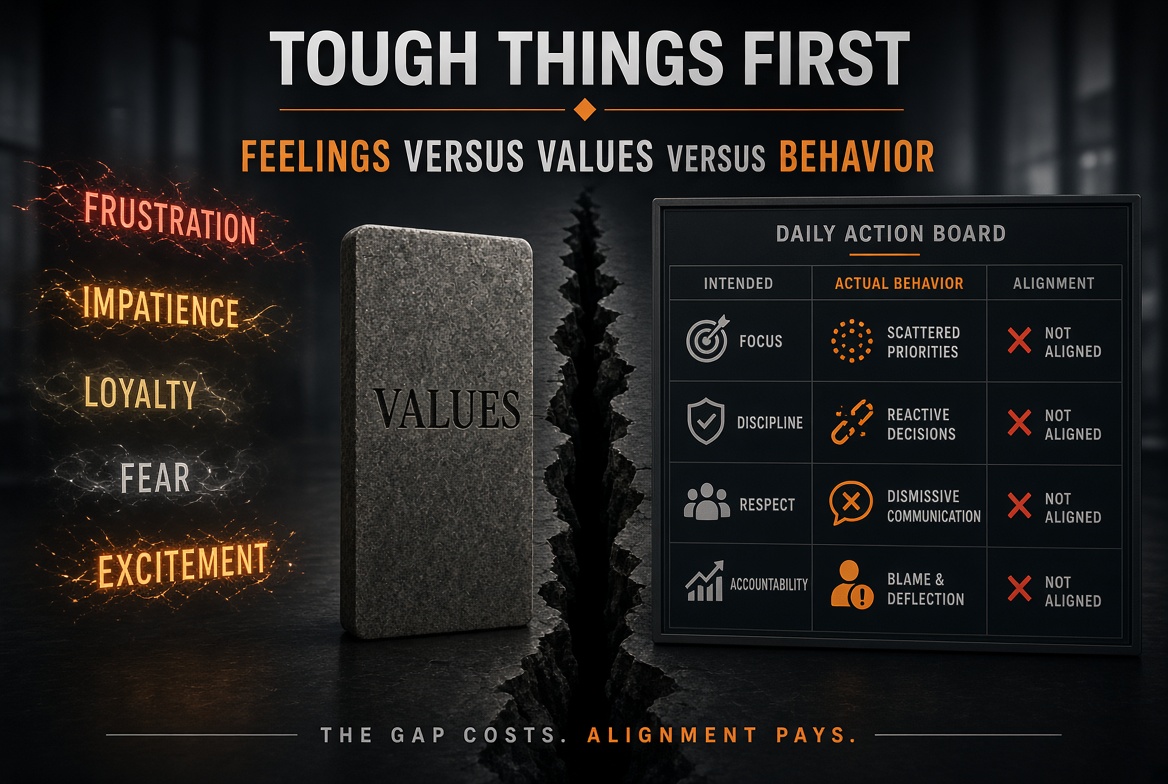
Most leaders talk a good game about values and claim their feelings don’t drive them—until the gap between what they say and what they actually do starts quietly costing them trust, respect, and results. In this Tough Things First podcast, Ray Zinn, the longest serving CEO in Silicon Valley history, breaks down why feelings, stated values, and daily behavior have to line up, or people will notice and the price will keep rising.
Rob Artigo: Ray, today I want to talk about something that sounds simple but trips up a lot of leaders in organizations. Feelings versus, follow me on this, feelings versus values versus behavior. What you feel and what you say you value only matters really on a daily basis if your behavior lines up with them, if I’m following you correctly. Otherwise, people notice the gap and the gap starts to cost you. We all have feelings, frustrations, impatience, loyalty, fear, excitement, all those things together.
And most of us can list the values we claim to hold, integrity, fairness, things like excellence and respect, accountability. But the only thing the people around us can actually evaluate is what we do on a day-to-day basis. So Ray, is this something you’ve done a little… I mean, I know this is something that you’ve done a little writing about, so why don’t we just start off with a little bit about what you think and kind of your definition of feelings versus values versus behavior, and then we’ll go from there.
Ray Zinn: Your values are the things that you grew up with, the things that you hold near and dear, near and dear. Those things that define the culture of your organization and the values that you have. And then your feelings are something that are tangential to values. You may feel like, “Maybe I ought to take advantage of a customer or employee to help me overcome the situation that I’m in.” So then your feelings, you look at your values. Okay, well, what are my values? My values are different.
They tell me that I need to treat everybody lovingly and honestly and correctly. Even though you feel like your employee or your customer has taken advantage of you, your feelings and your values get into a conflict. Now your behavior is how you react to the situation. If you’re true to your values and forget about your feelings, you’re just true to your values, then it’s very consistent. Your behavior will be very consistent because it’s based on your value system as opposed to just how you feel about something.
I know that sometimes we feel strongly about something that’s in conflict with our value system, and as long as we don’t act upon those, then we’re okay because constantly our feelings and our values are in constant evaluation because feelings are very strong. Feelings are actually as strong or stronger than values because that’s how you feel at the moment. If your behavior reflects your feelings, oftentimes you’re going to go awry. You’re going to end up with a difficult problem.
Maybe you’ll end up in jail even. If you have a strong value system that’s a good culturally based system, then your feelings will tend to be subverted to those values and your behavior then will be correct because they’ll be based on your values. Now, if your values are bad, then of course your feelings and your values match up and your behavior will be such that will actually take you in a bad direction. So the purpose of what we’re discussing today is to make sure you have a very good and strong value system.
It’s based on honesty, integrity, respect and dignity of everyone and then just doing whatever it takes, doing the tough things first. That’s a strong cultural value system and then your behavior will represent what your values are. If you let your feelings get involved, such as losing your temper, using swear words and vulgarity and other things as you lash out, and even though your value system says, “No, we don’t do that,” your values are being subverted to those feelings which erupt because your feelings are, “How do I feel at the moment?”
And then my behavior responds and say, “Oh man, I’m so sorry. I didn’t mean to do that.” But then you end up in trouble, whether it be in the way you treat others and maybe how you treat your customers or even yourself or your family. Having a strong value system is key to having a good culture in your organization. Make sure it’s based on good, sound principles, ones that are long-lasting, everlasting and not just the cultural norm at the moment, whether it be DEI or something like that.
Make sure that your value system has longevity to it, that’s not going to be up and down like a yo-yo. And then your feelings, if you have a strong value system, your feelings will then represent what your values are and then that will be reflected in your behavior. How do you respond then. Even though you feel like tearing somebody’s head off, you back off, you count to 10 and you deal with it in a very positive manner and then that behavior then will represent your values.
Rob Artigo: Yeah. It seems like a lot of people forget to pause and give themselves a chance to rethink what’s going to come out of their mouth next. Because the feelings, like you said, it becomes spontaneous and you react under feelings really fast and it’s usually not good, the first thing that you think of saying.
Let me ask you this, you’ve written a lot, your books have covered this a lot, which is I mean, about leadership in general. So within this context, why is it so easy for some leaders to get confused? And confused, I mean by what they feel or what they say they believe with what they actually do. So they confuse this whole process and they don’t do what they say they feel or believe.
Ray Zinn: Because they have a weak value system. In other words, their values are not inherent in their beliefs and the way that they will live their life, whether it be at home or in the community or at work. Your value system should be inherent in the way you interact with others. And the stronger your value system is, the less likely your feelings are going to interrupt or overtake those values. Because as we talked about in the beginning, that’s reflected in your behavior.
The thought proceeds the action. So if your thoughts are right, if you’re thinking correctly, then your reaction to those thoughts are going to be positive. So again, the purpose of this podcast is to make sure you evaluate your value system and make sure it’s good, it’s inherent in your way you interact with others and you’re not acting two-faced or speaking out of both sides of your mouth. Your actions speak louder than your words as you would.
Rob Artigo: Well, as we wrap this podcast up, Ray, I keep thinking about this core idea of feelings and claimed values only carry weight when the behavior matches them. And you also mentioned that if you have bad feelings and your values are flawed and your behavior matches them, that’s not good either. So.
Ray Zinn: It’s usually reflected in having a weak value system. In other words, if you have a wishy-washy value system, as you say one thing, but you act like in another, then people notice that. They notice as they say, “Do as I say, not as I do.” You’re not a very good example. What you say and what you do should be the same. Of course, having the right kind of value system, if you’re looking at joining a company or starting a company, look at the value system.
Look at what are the values that we’re going to have as a company? Are we going to focus on revenue? Are we going to focus on profitability? Are we going to focus on low turnover in our company? Are we going to focus on customer first? What’s going to be our values? And just because you have some money to start a company doesn’t mean you start it. You got to set it up right. You got to introduce it correctly. You got to have the right value system already in place so that when your company runs into problems or difficulty, that your behavior will reflect those values.
Rob Artigo: Well, I appreciate that straight talk, Ray. I think some of the fundamental things that a leader needs to address as they endeavor. Like you said, starting a business, you want to be prepared before you actually start the business. So this is one of those areas where the hard work is mostly internal, but the effects show up everywhere else. I mean, they show up because you’re an example of either good values or bad values and everybody in the company starts to emulate you. So-
Ray Zinn: You know.
Rob Artigo: Yeah.
Ray Zinn: We’re actually seeing this, Rob, in the political environment we’re in right now. Our history, the values that we’ve had in the past are going to come to the surface. People are going, “Well, I’m going to change. I’m not going to be that way now.” And people say, “Yeah, right.” A leopard doesn’t change its spots. So your history will come back to help you or haunt you. And especially in today’s environment where everything is documented digitally and it’s everywhere.
I mean, you can find it anywhere on the internet. Your past is your present. I mean, it’s going to be what you’re going to be gauged by now, not just, “Well, that’s the way I used to be. I’m a different person now.” And that may be true, but your past is still going to come back. It’s still going to be there. People are going to say, “Well, this is the way you were. Why should I believe you’re going to change in the future?”
Rob Artigo: Yeah. And it’s remarkable because people forget that they can delete their tweets or whatever all they want, but somebody has recorded the state of the internet at a moment when you were compromised with those things that you said. So it’s like you, man, and we could go on forever about the politicians as we head into an election, the things that are coming back to haunt people is pretty remarkable.
Anyway, let me get to the listeners here. Let them know they can join the conversation at toughthingsfirst.com. Questions and comments are always welcome there. Follow Ray on X, Facebook, and LinkedIn, and of course pick up Ray’s books, Tough Things First, The Essential Leader and the Zen of Zinn series one, two, and three, now including Ray’s book, Zen of Zinn Daily. Until next time, do the tough things first, right, Ray?
Ray Zinn: Absolutely. That’s the key to success.
